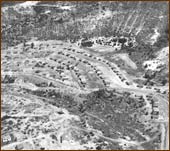
History of Trail
In 1890 the discovery of gold/copper ore on the face of Red Mountain by Joe Moris and Joe Bourgeois was the single most important event in the history of Trail and the Trail/Rossland area. The five claims staked by Moris and Bourgeois on Red Mountain in July of that year led to the rise of Rossland as the premier mining center in North America and the birth of the settlement we now call the City of Trail.
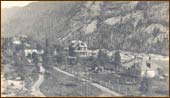
Under British Columbia law only four of the five claims could be recorded at the Nelson Mine Recorder's Office. The deputy mining recorder, Eugene Sayre Topping, agreed to pay the recording fees for the claims in return for ownership of the fifth claim. Topping and his friend, Frank Hanna, then purchased 343 acres at the mouth of Trail Creek on the Columbia River, hoping the claims on the neighbouring Red Mountain would be developed into paying mines, and make them wealthy through the sale of town lots. Their hopes became a reality in 1895. The Rossland mines proved to be very rich in gold/copper ore and the lots in the Trail Creek townsite sold briskly.
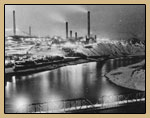
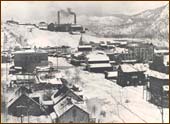
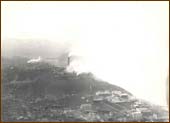
In 1895 Topping provided land to F.A. Heinze of Butte, Montana to build a smelter to treat the Rossland ores. The smelter was purchased by the C.P.R. in 1898 and expanded its production to include lead ores. Despite the difficult economic times, the smelter succeeded.
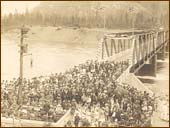
With the success of the smelter, the small town of Trail grew. On June 14th, 1901 the City of Trail was incorporated. The townspeople celebrated the historic event and what seemed to be a promising future on July 1st. In 1906 the smelter, the War Eagle, Centre Star, and St. Eugene mines, along with the Rossland Power Company were amalgamated to form the Consolidated Mining and Smelting Company of Canada Limited (CM&S). Under the direction of Walter H. Aldridge, the CM&S solidified the smelter operations.
top of page
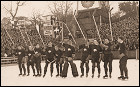
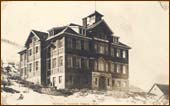
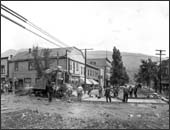
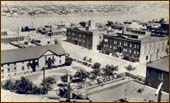
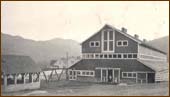
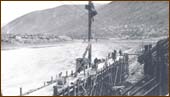
As the smelter stabilized, the town prospered and the city council concentrated on providing improved civic services. In 1912 a new brick school was built, and a bridge was constructed across the Columbia River. Trail Creek, running through the town, was culverted and the gully filled with smelter slag, doubling the building area of the downtown area. The Trail Fall Fair Building/Rink was built on Bay Avenue in 1911. Gradually improvements to the smelter increased production and employment in Trail.
As World War I approached, an end of an era was near. In 1911 Aldridge left Trail for Thompson, Nevada, and in 1914 Heinze died in New York, in financial ruin. The CM&S purchased the Sullivan Mine in Kimberley in 1910, and the smelter began to rely primarily on lead/zinc ores for its livelihood.
World War I increased the demand for lead and zinc and the CM&S realized the need to develop a better means to treat zinc ores. Ralph W. Diamond was hired to develop a process to treat the rich lead/zinc ores of the Sullivan Mine. His research led to a breakthrough in treating zinc ore with the development of the zinc electrolytic refining process. In 1917 labor unrest developed at the smelter and consummated with a general strike lasting 36 days. As well, in 1918, the community was hit hard by an influenza epidemic that swept through the province.
top of page
In the 1920s, under the direction of S.G. Blaylock, the CM&S expanded its Trail operations and increased its production of lead and zinc. With expansion of the smelter operations, the city prospered. The population increased as the demand for workers at the smelter grew.
Civic improvements were undertaken, including: in 1926 the installation of concrete paved roads in the downtown area (the first in the interior of British Columbia), expansion of schools, construction of a new hospital on Victoria Street in 1926, development of the Violin Lake Waterworks in 1919, and construction of large brick commercial buildings such as: the Memorial Hall, the Knights of Pythias Hall, Crown Point Hotel, Merchantile Store, the Company Store and City Hall.
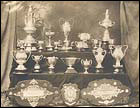
Social activities flourished with the production of plays and musicals; bands, orchestras and choirs were formed, sporting activities increased, and CJAT radio was established.
top of page
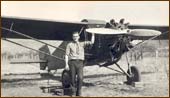
In the 1930s the CM&S constructed a chemical fertilizer plant in Warfield to reduce sulphur dioxide emissions in the valley. Zinc and lead production steadily increased. Exploration for new mines in the Northwest Territories led the CM&S to become pioneers in aviation exploration, which led to the Columbia Gardens Airport being constructed. A dairy was also established by the CM&S in Warfield, which provided milk to the townspeople.
The city expanded to the east side of the river. Tadanac was incorporated as a separate municipality in 1922. The residential area of Warfield was developed with the assistance of the CM&S. However, the Depression resulted in the curtailment of production and a reduction in wages. The government established make-work projects such as the Esplanade river wall and the highway to Castlegar to help displaced workers. Smelter employees cooperated by participating in work-sharing programmes.
top of page
The CM&S supported its employees with the establishment of hospital and medical insurance plans, sickness and benefit plans, house mortgages, and financial contributions to major civic projects.
During World War II, production at the smelter was increased to assist with the war effort. The West Kootenay Power Plants on the Kootenay River were expanded and CM&S participated in the development of the atom bomb. On May 8, 1945, Blaylock died and Diamond assumed management of the smelter operations. With the end of World War II, another era in Trail's history had come to an end.
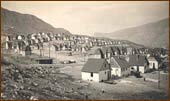
The city entered a period of post-war expansion with the development of residential areas of Sunningdale, Glenmerry, Shavers Bench, and the establishment of Warfield, Montrose, and Fruitvale as bedroom communities to Trail. The Trail smelter had grown to become the largest lead/zinc smelter in the world and Trail was the fourth largest city in British Columbia.
The city of Trail had become a lasting legacy to the modest visions of E.S. Topping and Frank Hanna in 1890.